Showing posts with label pluto. Show all posts

Friday, January 06, 2017


The bladed terrain of Pluto’s Tartarus Dorsa region, that were photographed by NASA's New Horizons spacecraft during its epic flyby in July 2015, as ice ridges 1,650 feet or so tall.  On Earth, these structures rise just a few feet above the ground in cold, mountainous regions of Earth.

The gargantuan size is predicted by the same theory that explains the formation of these features on Earth. 

On Earth however the structures are made up of snow or water ice, whereas Pluto's ridges are mostly methane and nitrogen ices. 

Researchers say that Pluto's structures probably formed within the past few tens of millions of years.

Monday, December 07, 2015

NASA Releases New High Rez New Horizon Pics


NASA's New Horizon probe was launched January 2006 and after nine and a half years and 3 billion miles, has sent back the clearest photos of Pluto. These pics are 10 times the resolution of previous pictures, and shows, Pluto's moon Charon as well as its other satellites.

 New Horizon began its historic pass in July of 2015 and began transmitting data almost immediately. However due to its distance and small, low power transmitter, New Horizon will be sending data well into 2016 before the thousands of picture that were taken are transmitted back to Earth.

Click HERE for more photos and info

Friday, July 17, 2015

Ice Mountains on Pluto


Icy mountains on Pluto are among the several discoveries announced Wednesday by Nasa's New Horizons team, just one day after the spacecraft’s first ever Pluto flyby.

A new close-up image of an equatorial region near the base of Pluto’s bright heart-shaped feature shows a mountain range with peaks jutting as high as 11,000 feet above the surface of the icy body.

Tuesday, July 14, 2015

New Horizon Probe Arrives at Pluto


It is easy to be amazed at the newest photo of Pluto.  Just the Herculean effort to get NASA's New Horizons probe 3 billion miles in 9 years, and then to take the clearest photos mankind has ever seen.  The photos it is now beaming back to Earth will be nothing short of stunning.

The spacecraft has made it closer to Pluto than any other in history, coming within 7,800 miles from the surface of the dwarf planet, snapping high-res photos in the process.  The photo above was taken July 13, I for one can not wait until the photos that New Horizon is beaming our way, are made available.

New Horizon is on a high speed pass and as such will not be sticking around long (a few hours at most), then it is off into the deep black of the Kuiper belt then deeper towards the Ort cloud.


Wednesday, April 29, 2015


After traveling more than 3 billion miles, NASA's New Horizon probe was woken by controllers fro it's most recent 'nap'.  As a side note, New Horizons has spent most of the trip hibernating in 18 controlled naps which NASA says will help preserve the probe's systems.

Since it woke, the craft has used its various cameras to photograph Pluto.  Here however is New Horizon's first color picture of Pluto and it largest moon Charon.

New Horizon's schedule has it doing a high speed flyby in mid June of this year.  The probe is already closer to Pluto than Earth is to the Sun.

Wednesday, April 15, 2015

New Horizons Closing for July Flyby


I know I am being a bit redundant   -  but you have to admit that as far as NASA's New Horizons mission is concerned  -  It is  starting to heat up in the coldest part of the solar system.

NASA’s New Horizons Spacecraft is nearing its History making July 14 Encounter with Pluto, giving us up close data that here to fore has been from ground based and Earth orbiting space observations.

This means that the New Horizons spacecraft will be sending back  first-ever close up images  of distant Pluto and its moons.

New Horizons is the fastest spacecraft ever launched, has traveled a longer time and farther away – more than nine years and three billion miles – than any space mission in history to reach its primary target. (voyager may have traveled further but had completed its mission and reached it primary target decades ago)

Its flyby of Pluto on July 14 will complete its primary mission, but may also open the door to new data in the Kuiper Belt, a large area beyond Neptune’s orbit with with numerous and interesting objects.

Interestingly, even with New Horizons closer to Pluto than the Earth is to the Sun, the Pluto system resembles little more than bright dots in the distance. That's enough however for the team team operating the spacecraft to  navigate New Horizons toward a  target 7,750 miles from Pluto’s surface. This is critical, since the craft's computer can not receive commands in real time and it needs to know where to  point its science instruments as it  passes Pluto.

Another real interesting data point:  New Horizons’s work doesn’t end with the flyby. Because its time close to Pluto is so short, New Horizons is designed to gather as much data as it can, as quickly as it can,which means, taking about 100 times as much data on close approach as it can send home before flying away.  The spacecraft will send the data stored in onboard memory for a full 16 months after close approach.

For more on the New Horizons mission, here is the NASA link http://www.nasa.gov/newhorizons

Tuesday, January 27, 2015

NASA's New Horizon Begins Pluto Encounter


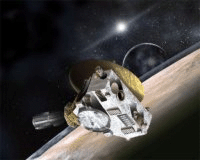
NASA's New Horizon began one of many approach configuration, as it closes with a flyby of  Pluto. 
These will culminate July 14 with the first close-up flyby of the dwarf planet, 4.67 billion miles  from Earth.

Since New Horizons launch in January 2006 - It has voyaged more than 3 billion miles.  It was awakened last month for its close pass to Pluto and inside the orbits of its five known moons.

The heavy duty science will begin this spring.  This will be the time when the cameras and spectrometers aboard New Horizons will be able to provide image resolutions higher than the most powerful telescopes on Earth. Eventually, the spacecraft will obtain images that scientists hope will be good enough to map Pluto and its moons more accurately than achieved by previous planetary reconnaissance missions.


http://www.nasa.gov/press/2015/january/nasa-s-new-horizons-spacecraft-begins-first-stages-of-pluto-encounter/

Wednesday, August 27, 2014

New Horizon Passes Neptune On To Pluto


NASA's New Horizon has crossed Neptune's orbit on it's way to a 7-14-2015 rendezvous with Pluto.

This puts New Horizon some 2.75 billion (yep, that's billion with a B)  miles from Earth and 2.48 billion miles from Neptune proper.  This milestone has only happened once before when the mark was set by Voyager 2, which accomplished a much closer  fly-by on August 25th of 1989.

Voyager’s visit to Neptune revealed features never seen before.  Such as the Great Dark Spot, a massive storm much like Jupiter’s Great Red Spot. Voyager also captured clear images of the ice giant’s ring system, too faint to be clearly viewed from Earth.

Considering the historic observations of Voyager 1 and 2, New Horizons' controllers are confident that it is also on a path toward discoveries in the Kuiper Belt.   A realm of icy objects out past the orbit of Neptune.

NASA New Horizon Neptune orbit crossing article HERE + Wikipedia New Horizon 


Wednesday, July 23, 2014

New Horizon now less Than a Year Away From Pluto

NASA's New Horizon space probe is one year away from it's rendezvous with Pluto.

New Horizon will will do its fly by on July 15, 2015.  This will be the first time Pluto has been visited up close or otherwise. 

Pluto orbits the sun at an average distance of 3.65 billion miles which gives it an orbital duration of 248 years!


Get more at the web site HERE @ Space dot Com

Thursday, July 21, 2011

What's Pluto Got That Earth Doesn't?


Well according to this article on NASA's site Three more moons is what. Now I hear ya saying, hey wait, Pluto only has 3 moons. Wrongo! Hubble just found the smallest Pluto moon so far still designated P4.

From the NASA article:
  • The new moon is the smallest discovered around Pluto. It has an estimated diameter of 8 to 21 miles. By comparison, Charon, Pluto's largest moon, is 648 miles across, and the other moons, Nix and Hydra, are in the range of 20 to 70 miles in diameter.
The new moon is located between the orbits of Nix and Hydra and is believed to have formed by a collision between Pluto and another planet-sized body early in the history of the solar system, as were the other three Plutonian moons.

All this work is support work to support NASA's New Horizons mission, scheduled to fly through the Pluto system in 2015.


photo computer generated from Hubble photos - complete gif and info here

Tuesday, November 23, 2010

Pluto's Status Changes Once again.


Tim Sayell writes -First is one, then it's not....then it is one...then it's not... You know what I think? I think two scientists in white coats find an empty observatory somewhere and just flip a coin...
Anyway, Pluto might be a planet again.

Well that might be a bit hasty, but according to the Yahoo News article that Tim sent in Pluto has become the largest body in the outer solar system. It seems that with further observation, Eris (the body that caused all this trouble with Pluto.) has had it's size placed at somewhat smaller than Pluto. Not by much mind you, they are so close as to be almost the same size. That is precisely what makes many astronomers uncomfortable. With the discovery of Eris, it became clear that the outer reaches of the Solar System contain many Pluto class bodies. If Pluto was a planet then the very real possibility arose that instead of nine planets we would have literally hundreds of them. If Eris was not a planet then smaller Pluto could not be one either.

It makes sense. The smallest recognized planet in the inner system is Mercury which is only 3,000 miles in diameter, Pluto is less than half that at about 1400 miles. Also all the inner planets have basically circular orbits all in the same plane. Kuiper objects like Pluto and Eris have eccentric orbits that are tilted to the normal planetary plane.

But it is not only size that determines a planet. One of the criteria says that a planet must be able to clear all other bodies in it's orbital plane. All the planets out to Neptune have done just that. The thing is that as you move away from the sun your orbit becomes much larger. It becomes much harder, only gas giants are capable of the job that far away from Sol. The curious thing is, according to the Yahoo article, that if Earth were moved to Pluto's orbit, it could not clear it's orbit and therefor would not be a planet, which is clearly ridiculous.

So the argument still goes on it would seem. Check out the article at Yahoo News for the pros and cons of Pluto's planethood. HERE

Friday, February 05, 2010

Pluto Changing Color?!


From Yahoo News comes an article from Tim Sayell that tells about some weird goings on with the surface of Pluto. Recent photos taken of the dwarf planet, by the Hubble Space Telescope, show a dramatic shift towards the red end of the spectrum on Pluto's surface.

Hubble photos show frozen nitrogen on Pluto's surface growing and shrinking, brightening in the north and darkening in the south.
  • Astronomers say Pluto's surface is changing more than the surfaces of other bodies in the solar system.
Unprecedented and surprising are words used to describe the changes, especially on a surface that has seasons lasting as long as 120 years.

From 1954 to 2000, photographs of Pluto did not change. Then in the next 2 years there was up to a 30% increase in red coloration. Scientist can explain the redness, just not why it changed so quickly. From the article:
  • The planet has a lot of methane, which contains carbon and hydrogen atoms. The hydrogen gets stripped off by solar winds and other factors, leaving carbon-rich areas on the surface, which tend to be red and dark.
  • Part of the difficulty in figuring out what is going on with Pluto is that it takes the dwarf planet 248 years to circle the sun, so astronomers don't know what conditions are like when it's is farthest from the sun. The last time Pluto was at its farthest point was in 1870, which was decades before Pluto was discovered.
complete article

Wednesday, December 30, 2009

New Horizons spacecraft sets new milestone


From Wired is a report on the status of the New Horizons probe. The craft is now closer to Pluto than it is to Earth, plus it reached that historic point in less than four years.

New Horizons is the fastest space-craft ever built. At present it is traveling at 31,000 miles an hour and is located about 1.527 billion miles from Earth.

From the article:
  • The spacecraft will be the first to flyby Pluto and on to the other objects lurking in the Kuiper Belt at the edge of the solar system.
New Horizons is not an orbiter. It will do a flyby of Pluto on July 14, 2015. In the nine day period as the probe approaches, flies by and continues on, it is planned to acquire almost 5 gigabytes of data that will take months to transmit back to Earth. Due to the extreme distances it takes a signal over four hours to reach Earth from Pluto.

read complete Wired article here

Wednesday, June 11, 2008

'Plutoid' Chosen As Name For Dwarf Planets Like Pluto


Almost two years after the International Astronomical Union (IAU) General Assembly introduced the category of dwarf planets,The IAU has decided on the term plutoid as a name for dwarf planets like Pluto. This category is for solar system objects called trans-neptunian which are celestial bodies in orbit around the Sun at a distance greater than that of Neptune that have sufficient mass for their self-gravity to overcome rigid body forces so that they assume a hydrostatic equilibrium (near-spherical) shape, and that have not cleared the neighbourhood around their orbit. The two known and named plutoids are Pluto and Eris. The dwarf planet Ceres is not a plutoid as it is located in the asteroid belt between Mars and Jupiter.

Tuesday, April 03, 2007

Fastest Rotating Object in Our Solar System Is One of Strangest

On 1994 July 16-22, over twenty fragments of comet Shoemaker-Levy 9 collided with the planet Jupiter. Before that time, even though there was ample evidence, direct observation of an impact between object in our Solar System had no solid proofs. Now it's commonly accepted that comets have and will continue to fall on their heavenly neighbors. Collisions between even more massive object was accepted as statistically unlikely and had not been observed in astronomical history. That was until a big rock called 2003 EL61, which is almost the size of Pluto, was discovered. In the Kuiper Belt where most object are made up of ice, resides El61, an extremely large rocky body. Not only is this huge rocky object there, it is the only object in our solar system shaped like an American football and tumbling long end-over-end every four hours, making it one of the fastest spinning object in our Solar System. Planetary astronomer Michael Brown, Ph.D., at Cal Tech, says he has discovered icy satellites in the EL61 region that have surface properties nearly identical to those of 2003 EL61. These satellites suggest a gigantic impact long ago. Brown thinks that EL61 was once covered in ice and as large as Pluto. Some time ago EL61 was struck a glancing blow at extremely high speed, by another rocky body, maybe as much as 60% of EL61's mass. This type of collision would have blown off the outer ice mantle and sped up the rotation. The spin itself would have pulled it out into the shape like the football. It is just such a collision with a Mars sized planet that might have been responsible for splitting of a major piece of crust and forming Earth's satellite - the Moon

Submitted by Shaun Saunders

Thursday, March 01, 2007

Probe spies Jupiter's moon Io's volcanic plume


Nasa's New Horizons spacecraft has sent back images of a huge volcanic eruption on Jupiter's moon Io. A massive dust plume, estimated to be 150 miles (240km) high, can be seen erupting from Io's Tvashtar volcano. On Wednesday, the US probe flew by Jupiter, using the planet's gravity to boost its speed, reducing the travel time to its ultimate target of Pluto. New Horizons also took photos of the icy moons Europa and Ganymede in the run-up to its encounter with Jupiter. New Horizons made its closest approach to Jupiter on Wednesday, passing within 2.3 million km (1.4 million miles) of the planet. The probe will carry out more than 700 observations of the Jupiter system by June, in a dry run for its planned rendezvous with Pluto and its moons in 2015.

posted by Shaun A. Saunders

Friday, October 27, 2006

Pluto Time Capsule: submit your stuff for space by Nov. 1


When New Horizons arrives at Pluto in nine years, Earth will be a different place than the world the spacecraft left behind. To mark that passage of time, The Planetary Society, in conjunction with the New Horizons mission, sponsored a contest for children and adults to send a message to future Earth - a New Horizons Digital Time Capsule of photographs of the world today to the inhabitants of 2015. Participants whose photos are selected for the time capsule will be eligible to win a grand prize trip to New Horizons mission control at the Johns Hopkins University Applied Physics Laboratory in Maryland to witness the Jupiter flyby in February 2007.