Showing posts with label new horizons. Show all posts

Friday, July 17, 2015

Ice Mountains on Pluto


Icy mountains on Pluto are among the several discoveries announced Wednesday by Nasa's New Horizons team, just one day after the spacecraft’s first ever Pluto flyby.

A new close-up image of an equatorial region near the base of Pluto’s bright heart-shaped feature shows a mountain range with peaks jutting as high as 11,000 feet above the surface of the icy body.

Wednesday, April 29, 2015


After traveling more than 3 billion miles, NASA's New Horizon probe was woken by controllers fro it's most recent 'nap'.  As a side note, New Horizons has spent most of the trip hibernating in 18 controlled naps which NASA says will help preserve the probe's systems.

Since it woke, the craft has used its various cameras to photograph Pluto.  Here however is New Horizon's first color picture of Pluto and it largest moon Charon.

New Horizon's schedule has it doing a high speed flyby in mid June of this year.  The probe is already closer to Pluto than Earth is to the Sun.

Wednesday, April 15, 2015

New Horizons Closing for July Flyby


I know I am being a bit redundant   -  but you have to admit that as far as NASA's New Horizons mission is concerned  -  It is  starting to heat up in the coldest part of the solar system.

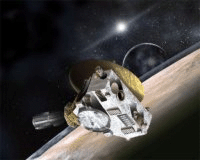
NASA’s New Horizons Spacecraft is nearing its History making July 14 Encounter with Pluto, giving us up close data that here to fore has been from ground based and Earth orbiting space observations.

This means that the New Horizons spacecraft will be sending back  first-ever close up images  of distant Pluto and its moons.

New Horizons is the fastest spacecraft ever launched, has traveled a longer time and farther away – more than nine years and three billion miles – than any space mission in history to reach its primary target. (voyager may have traveled further but had completed its mission and reached it primary target decades ago)

Its flyby of Pluto on July 14 will complete its primary mission, but may also open the door to new data in the Kuiper Belt, a large area beyond Neptune’s orbit with with numerous and interesting objects.

Interestingly, even with New Horizons closer to Pluto than the Earth is to the Sun, the Pluto system resembles little more than bright dots in the distance. That's enough however for the team team operating the spacecraft to  navigate New Horizons toward a  target 7,750 miles from Pluto’s surface. This is critical, since the craft's computer can not receive commands in real time and it needs to know where to  point its science instruments as it  passes Pluto.

Another real interesting data point:  New Horizons’s work doesn’t end with the flyby. Because its time close to Pluto is so short, New Horizons is designed to gather as much data as it can, as quickly as it can,which means, taking about 100 times as much data on close approach as it can send home before flying away.  The spacecraft will send the data stored in onboard memory for a full 16 months after close approach.

For more on the New Horizons mission, here is the NASA link http://www.nasa.gov/newhorizons

Tuesday, January 27, 2015

NASA's New Horizon Begins Pluto Encounter


NASA's New Horizon began one of many approach configuration, as it closes with a flyby of  Pluto. 
These will culminate July 14 with the first close-up flyby of the dwarf planet, 4.67 billion miles  from Earth.

Since New Horizons launch in January 2006 - It has voyaged more than 3 billion miles.  It was awakened last month for its close pass to Pluto and inside the orbits of its five known moons.

The heavy duty science will begin this spring.  This will be the time when the cameras and spectrometers aboard New Horizons will be able to provide image resolutions higher than the most powerful telescopes on Earth. Eventually, the spacecraft will obtain images that scientists hope will be good enough to map Pluto and its moons more accurately than achieved by previous planetary reconnaissance missions.


http://www.nasa.gov/press/2015/january/nasa-s-new-horizons-spacecraft-begins-first-stages-of-pluto-encounter/

Wednesday, August 27, 2014

New Horizon Passes Neptune On To Pluto


NASA's New Horizon has crossed Neptune's orbit on it's way to a 7-14-2015 rendezvous with Pluto.

This puts New Horizon some 2.75 billion (yep, that's billion with a B)  miles from Earth and 2.48 billion miles from Neptune proper.  This milestone has only happened once before when the mark was set by Voyager 2, which accomplished a much closer  fly-by on August 25th of 1989.

Voyager’s visit to Neptune revealed features never seen before.  Such as the Great Dark Spot, a massive storm much like Jupiter’s Great Red Spot. Voyager also captured clear images of the ice giant’s ring system, too faint to be clearly viewed from Earth.

Considering the historic observations of Voyager 1 and 2, New Horizons' controllers are confident that it is also on a path toward discoveries in the Kuiper Belt.   A realm of icy objects out past the orbit of Neptune.

NASA New Horizon Neptune orbit crossing article HERE + Wikipedia New Horizon 


Wednesday, July 23, 2014

New Horizon now less Than a Year Away From Pluto

NASA's New Horizon space probe is one year away from it's rendezvous with Pluto.

New Horizon will will do its fly by on July 15, 2015.  This will be the first time Pluto has been visited up close or otherwise. 

Pluto orbits the sun at an average distance of 3.65 billion miles which gives it an orbital duration of 248 years!


Get more at the web site HERE @ Space dot Com

Wednesday, December 30, 2009

New Horizons spacecraft sets new milestone


From Wired is a report on the status of the New Horizons probe. The craft is now closer to Pluto than it is to Earth, plus it reached that historic point in less than four years.

New Horizons is the fastest space-craft ever built. At present it is traveling at 31,000 miles an hour and is located about 1.527 billion miles from Earth.

From the article:
  • The spacecraft will be the first to flyby Pluto and on to the other objects lurking in the Kuiper Belt at the edge of the solar system.
New Horizons is not an orbiter. It will do a flyby of Pluto on July 14, 2015. In the nine day period as the probe approaches, flies by and continues on, it is planned to acquire almost 5 gigabytes of data that will take months to transmit back to Earth. Due to the extreme distances it takes a signal over four hours to reach Earth from Pluto.

read complete Wired article here

Thursday, March 01, 2007

Probe spies Jupiter's moon Io's volcanic plume


Nasa's New Horizons spacecraft has sent back images of a huge volcanic eruption on Jupiter's moon Io. A massive dust plume, estimated to be 150 miles (240km) high, can be seen erupting from Io's Tvashtar volcano. On Wednesday, the US probe flew by Jupiter, using the planet's gravity to boost its speed, reducing the travel time to its ultimate target of Pluto. New Horizons also took photos of the icy moons Europa and Ganymede in the run-up to its encounter with Jupiter. New Horizons made its closest approach to Jupiter on Wednesday, passing within 2.3 million km (1.4 million miles) of the planet. The probe will carry out more than 700 observations of the Jupiter system by June, in a dry run for its planned rendezvous with Pluto and its moons in 2015.

posted by Shaun A. Saunders

Friday, October 27, 2006

Pluto Time Capsule: submit your stuff for space by Nov. 1


When New Horizons arrives at Pluto in nine years, Earth will be a different place than the world the spacecraft left behind. To mark that passage of time, The Planetary Society, in conjunction with the New Horizons mission, sponsored a contest for children and adults to send a message to future Earth - a New Horizons Digital Time Capsule of photographs of the world today to the inhabitants of 2015. Participants whose photos are selected for the time capsule will be eligible to win a grand prize trip to New Horizons mission control at the Johns Hopkins University Applied Physics Laboratory in Maryland to witness the Jupiter flyby in February 2007.