Showing posts with label spitzer. Show all posts

Tuesday, September 02, 2014

Spitzer Notices Cosmic Smash-up


Scientists studying star NGC 2547-ID8 witnessed a  huge amount of new dust between  August 2012 and January 2013.  Speculation has it that two very large asteroids collided in that system. 

While asteroid collisions have been observed by Spitzer before, this is the first time scientists have collected data before and after a smashup - offering a glimpse into the process of making planets like ours.

Check out the NASA site for the complete article HERE


Sunday, July 29, 2012

Pillars of Creation, Vaporized Thousands of Years Ago?

I had heard speculation of this a few years ago and even noted it.

Now it seems, if not confirmed, thought by today's astronomers to be very likely that the beautiful construct in the Eagle nebula, called the Pillars of Creation, may in fact have been destroyed thousands of years ago by the shock wave from a nearby supernova. This fact will be extremely hard to to confirm however. Because of the distance ( in overall stellar terms the pillars are pretty close, relatively speaking, some 7000 light years distant) it will be at least another millennium before the light from their destruction starts to reach us.

"The Pillars of Creation" was taken by the Hubble telescope in 1995. The Pillars are of great interest by astronomers because these columns of dust and gas are likely places where stars form. which makes the next time they were re-imaged turned out to be a bit melancholy. In 2007 researchers again focused on this region of space using the Spitzer Space Telescope. These new images showed the Pillars and next to them, a giant cloud of hot dust thought to have been heated by the blast of a star that possibly went supernova.
What's more this shock wave could have already reached the Pillars, causing them to disintegrate about 6,000 years ago. (hence the 1000 year estimate before we start to see evidence of the destruction)

Read more at the Daily Galaxy here

And an excellent break down of this information in the Wikipedia here

Wednesday, May 09, 2012

Light from Extra-Solar Planet - Seen for 1st Time

Whoooooooooo Hooooooooo blog fan Courtney sends in this article that left me tingling! Light from a planet circling a distant star was for the first time viewed by space telescopes in orbit around Earth! That my friends is what I call a historic achievement!

The scope doing NASA's heavy lifting for this discovery was the infrared Spitzer Space Telescope. The telescope spotted light coming from the alien planet with the rather innocuous moniker of 55 Cancri e. This Super Earth (so designated because its' size is roughly twice that of Earth and a mass density of about 18 times that of Earth) orbits a star 41 light-years from Earth.

Of course this is not the first time that Spitzer has pulled off this hat trick. In 2005 it also gathered IR light coming from an extra-solar planed, however this was "hot Jupiter," an ultra hot gas giant far larger than 55 Cancri e that orbited extremely close to its parent star.

The more 55 Cancri e is studied, the stranger it becomes. Not only is it ultra dense, it orbits 26 times closer than the distance between Mercury and our own sun!

Oh and it gets weirder! Here is the link to the article. Read just how nightmarish 55 Cancri e could really be!

Graphic is a plot of data from NASA's Spitzer …

Thursday, December 01, 2011

Ultra Red Galaxies Discovered


Science Daily reports of a news type of extreme galaxy discovered by NASA's Spitzer Space Telescope. These galaxies are so very red that not even Hubble can detect them. Spitzer it seems is much more sensitive to infrared than Hubble.

It would appear that the redness comes from a variety of causes. First is their great distance. At the very edge of the universe and created just 1 billion years after the big bang accounts for a great deal of red shift, at that distance the universe expansion causes massive red shift. Also these galaxies appear to be make up of mostly red stars plus the amount of dust between them and us causes attenuation of all but the longest wavelengths of light.

What makes these galaxies even more unusual is that at that distance, galaxies should be young proto galaxies for the most part. These galaxies have all the monikers of extreme age.

Read complete article here

photo is artist representation. courtesy of physorg.org

Monday, October 24, 2011

Mysteries of 2000 Y.O. Chineese Super-Nova Solved


Tim Sayell sends in an interesting article from Yahoo News concerning mysteries surrounding a 2 thousand year old super nova documented two Millennium ago in 185 A.D. by Chinese astronomers. This particular Super nova was the first of its' kind ever documented. Of course it wasn't until the 60s that scientists began to understand that this titanic explosion was the death throes of a star. But after finding many more such "super explosions " RCW 86 began to stand out as an odd set of data that seemed to contradict itself. The really obvious occurrence is that RCW-86 is more than twice the size (expansion) than any other super nova of it's type and age had any right being. (the article states that in infrared the expansion globe is larger than our full moon!)

Astronomers combined data from Spitzer and WISE telescopes with existing information from NASA's Chandra X-Ray Observatory and the European Space Agency's XMM-Newton Observatory.

Evidence suggests that RCW 86 may have been a binary star with RCW 86 being a sun much like our own. Stars like our SOL don't often explode, but an influx of fuel during the expansion to a red giant phase may have triggered a mild explosion and RCW 86 collapsed to a white dwarf, leaving a LOT of empty space around it. Any further fuel from the companion would mean that a much more energetic explosion was imminent.

When the supernova finally did take place, it did not encounter the regular dust that surrounds most of these type 1A explosions and expanded rapidly and continued for quite a while..


There is an excellent description of how the white dwarf and the companion star dynamic worked over at the yahoo site here.

Sunday, March 13, 2011

A Star Cooler than Boiling Water?


In a discovery that blurs the definition of what is a large planet and what is a small star comes a story from IO9 which details the discovery of a weird little beastie called a brown dwarf. We have known for some time that one of these strange little stars exists virtually in our backyard 63 light-years distant. But recently it's become clearer hows strange some of them are. Most of course are hardly larger than Jupiter. This means that Hydrogen fusion can not take place. (a mass 60 to 80 times the mass of Jupiter is needed) Brown dwarfs are often very dense animals. Though they may be about the size of Jupiter, they are many times more dense. It really is difficult to call them stars at all. The Spitzer telescope has uncovered a few brown dwarfs that are at most 16 Jupiter masses. Stranger still is their internal temperature is well below that of boiling water and one labeled WD 0806-661B may have a temperature of just 86 degrees Fahrenheit! How many hot days have you heard someone say "it's hotter than the surface of a star out today!" and now it could be a true statement! LOL.

Check out the rest of this weird article on the IO9 blog HERE

Thursday, October 28, 2010

"Buckyballs" Molecules Discovered in Another Galaxy


Dan just brought this to my attention. It seems that NASA astronomers using the Spitzer Space Telescope have discovered molecules dubbed Buckyballs throughout our galaxy. They are being discovered at such a rate that scientists are now saying that buckyballs are much more common and abundant in the universe than initially thought.

Much more common is the understatement of the hour. According to an article in Space.com, that the oddly configured carbon atom has been found by researchers :
  • throughout our Milky Way galaxy, in the space between stars and around three dying stars. They also detected the molecules around a fourth dying star in a nearby galaxy in staggering quantities — equivalent in mass to about 15 Earth moons
  • The miniature spheres were first discovered in a lab on Earth 25 years ago, but it wasn't until last July that Spitzer provided the first confirmed proof of their existence in space. At that time, scientists weren't sure if they had been lucky to find a rare supply, or if perhaps the cosmic balls were all around.
This discovery may prove to be very important as planetary nebulae that contain "buckyballs" also show many other chemical telltales that are considered important to life.

click here for more info at space.com

Wednesday, October 07, 2009

NASA discovers gigantic Saturn ring


Tim Sayhill sends in an article from Yahoo News that documents a startling discovery by the Spitzer Space Telescope. NASA's Jet Propulsion Laboratory announced that the telescope has discovered the biggest but never-before-seen ring around the planet Saturn.

The ring is made up of a very thin amalgam of dust and ice crystals. Due to the size of the material that makes up the ring an the extremely thin distribution, the ring reflects very little visible light. However the Spitzer's infra-red telescope could detect the ring with ease.

The bulk of the ring material starts about 3.7 million miles from the planet and extends outward about another 7.4 million miles, making it one of Saturn's largest rings by a sizable margin.

NASA astronomers note that Saturn's moon Phoebe orbits within the ring and is believed to be the source of the material.

Tuesday, December 09, 2008

Even needing repair, Hubble makes science history

A recent breakthrough using NASA's Hubble Telescope is an important step toward finding the chemical signatures of extraterrestrial life. Hubble has discovered carbon dioxide in the atmosphere of a planet orbiting another star. The planet in question, HD 189733b, is a Jupiter class gas giant that is too hot for life. However as the article in Science Daily suggests: ... the Hubble observations are a proof-of-concept demonstration that the basic chemistry for life can be measured on planets orbiting other stars. Organic compounds also can be a by-product of life processes, and their detection on an Earthlike planet someday may provide the first evidence of life beyond our planet.

The discovery of carbon dioxide is reason for a great deal of excitement because, under the right circumstances, it could have a connection to biological activity as it does on Earth and is significant for the long-term effort of characterizing planets to find out what they are made of and if they could be a possible host for life.


Tuesday, May 08, 2007

Did antimatter 'factory' spark brightest supernova?

The brightest supernova ever recorded may have been triggered by an exotic process involving antimatter in an extremely massive star, a new study says. The explosion may offer a rare glimpse of how the universe's first generation of stars died. The explosion was first spotted on 18 September 2006 and named SN 2006gy. It quickly became apparent that it was something out of the ordinary. To begin with, it broke the record for the intrinsically brightest supernova ever recorded. It now appears to have been an extremely massive star meeting its end in a highly unusual way that involves the production of antimatter. With 100 times the energy of a typical supernova explosion, SN 2006gy was simply too energetic to be explained by the explosion of a lightweight object like a white dwarf star. Research theory suggests that super massive stars (in the area of 150 times the mass of SOL) may not collapse in the same manner as normal supernova, but instead be ripped apart by much more exotic forces.
Click on the title to read the complete story

submitted by Shaun Saunders

Tuesday, May 01, 2007

Space telescopes image the Sombrero Galaxy

Data from a trio of space telescopes – Chandra, Spitzer and Hubble – have been combined to produce the new image of the sombrero Galaxy. Chandra observations reveal hot gas that glows in X rays and extends about 60,000 light years from the centre of the galaxy, which itself is only 50,000 light years wide. The gas is probably being blown outwards by a wind driven by supernova explosions in the galaxy.

Click on the article title to go to the site. They have an excellent short video of how the image of this galaxy was put together from the data from the other three telescopes.

submitted by Shaun A. Saunders

Monday, October 30, 2006

False color photo of exploding star


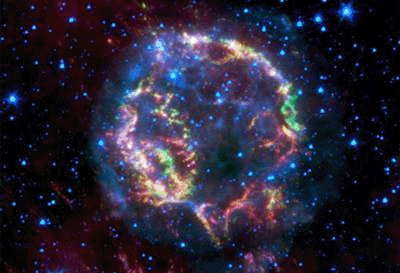
A false-color image taken by Spitzer. The faint blue glow surrounding Cassiopeia A is material energized by the faster-moving forward shock wave. Green, yellow and red primarily represent material that was ejected in the explosion and heated by the slower reverse shock wave. Click article title to link to the story for more information.