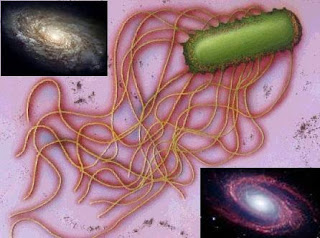
Past futurologist Timothy Leary is vindicated. As he predicted in 1977, genetic reproduction in a gravity free environment does indeed unlock or activate great swathes of the Terran genome, hitherto unexpressed.
At least that's what the results of a study recently released by the National Academy of Sciences suggest.
In "
Space Flight alters Bacterial Gene Expression" the forty (yes 40) authors observed that:
"Salmonella bacteria grown aboard the Space Shuttle on its STS 115 mission showed changes in the expression of 160 genes, with the RNA-binding protein Hfq in command....Global microarray and proteomic analyses revealed that 167 transcripts and 73 proteins changed expression with the conserved RNA-binding protein Hfq identified as a likely global regulator involved in the response to this environment."The researchers concluded that it was the absence of gravity that precipitated the novel gene expression.
Similarly in
Exo-Psychology Leary wrote that
"[t]he significance of extraterrestrial flight has not yet been fully understood. Just as land-dwelling organisms rapidly develop neural and physiological equipment for the new environment, this transition to zero-gravity and extraterrestrial radiation will trigger off genetic and neurological changes necessary to adapt to interstellar life.But as microbiologist Elio notes in his Small Things Considered blog, zero gravity is likely but one of the environmental changes the E Coli aboard the Shuttle went through:"Besides gravity, which is clearly the focus of this paper, they really should control for a less obvious but potentially much more important factor: radiation. Our atmosphere shields us from an enormous amount of the stuff. The bacterial cultures that flew got exposed to much higher levels of radiation than the cultures that stayed on the ground, so it's entirely possible that the increased virulence is due to a mutation and/or general stress on the DNA repair machinery.
Dove suspects that "the reason they didn't look at this is that it was much easier to do gene expression chip profiling, rather than doing whole-genome sequencing on both cultures."
In a related vein, the High Priest of Psychedelia described psychological/philosophical impacts of zero G on several veterans of the lunar expeditions, who experienced it for extended periods:
"The beginnings of exo-psychological adaptation can be noted in several lunar veterans who returned claiming cosmic insights (Mitchell), philosophic revelations (Schweickart), and rebirth symptoms (Aldrin). "
How, one wonders, has that held up for the new generation of International Space Stationeers? Ten years along, any neo-philosophers among them? What about their post- space station progeny?
(Image courtesy NASA and public domain)


